
Website visitor stats & reporting
Newsletter No 6 - July 2012
Welcome to my email newsletter on the topic of Making Your Website Work for You.
Amazingly we’re already near the end of July and just getting a glimpse of summer - two consecutive days of glorious sunshine! Last month was the UK's wettest June since records began in 1910. This year we’ve had the driest winter, the warmest February and the wettest April and June since records began. In England we’re obsessed with weather - every third newspaper headline is about weather – what it’s done and what we’re going to expect and weather forecasts take as much airtime as political stories on the news programmes. We like to count things, record things and try and spot trends. Unfortunately, despite hundreds of years of data collection and analysis we still get surprises with weather but the recording and analysis done by the Meteorological Office in the UK and other organizations around the world help to inform decisions for all kinds of events (though Glastonbury goers would probably be a bit disappointed if there was no mud!), water usage, flood prevention and crop growing.
But human beings are not as unpredictable as weather and studying behaviour of customers and prospects is what makes marketing possible. If you want to get your website to do a better marketing job for you it helps to have some information about your website visitors, where they came from, what questions they asked of search engines to get to you and what they did when they got to your website. Knowing more about your website visitors will help you make your website work better for you. So this month’s newsletter is about:
Website visitor stats & reporting
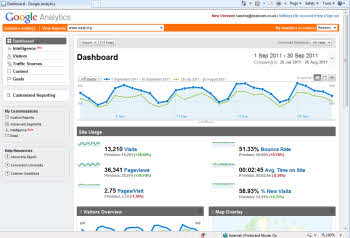 First you need to collect data.
There are various ways to collect visitor stats:
- A script on each page of your website which collects information and stores it for immediate or later analysis. Google Analytics is the best known of these.
- Your website host logs every access to every piece of your website – the page itself, images, buttons, script files etc you probably aren’t aware of. A single webpage can generate 30 or 40 or more lines in the log file. Some hosts make the log files available to you and it makes for fascinating reading on a rainy day if you have no freshly painted wall to watch dry! You need a computer application to analyse the data and generate useful reports.
- Hosting companies will usually supply a package such as AW Stats, Smarter Stats. You can usually set these up to produce regular weekly or monthly reports available on-line or emailed to you.
There are pros and cons about which stats system to use. Scripting packages like Google Analytics use cookies to track when a visitor views a page and can track how the visitor moves through your site to their eventual exit. They also use persistent cookies to track returning visitors. This is useful to get an idea of how many new visitors you are getting vs people who have already visited before. If you don’t want to use cookies on your website then you can’t use Google Analytics. Also if visitors have cookies turned off, or Javascript disabled, they won’t be counted.
If you want to log how many file downloads are happening, e.g. pdf product brochures, event flyers, PowerPoint presentations or videos, you need to make sure Google Analytics code is attached to each download code. The page script doesn’t do this automatically. However, the hosting stats will record those downloads, so if you have lots of files it might be better to rely on the hosting stats for this.
Note that none of these packages can identify individuals using your site. There are companies who claim to be able to identify when a particular prospect has visited your website so you can contact them and follow up. They do this either by identifying a visitor’s IP address (this could identify a large company who has a fixed IP) or by using cookies in conjunction with a mailing campaign.
You often find that stats reported from Google Analytics vary a bit from those generated by your host. This can be because:
- Google Analytics can’t collect visit info from visitors who have cookies or Javascript turned off.
- Although generally they exclude the major robots or spiders host systems often log such automated visits and include them in the visitor stats.
I generally use Google Analytics to provide an overview and back it up with info from the host stats package when I need to generate a more detailed report.
What information can you find?
- It’s useful to know how many people are visiting your website, although the important thing is the trend. It doesn’t really matter if you don’t get hundreds of visitors so long as you are getting the ones you want and are converting them to sales.
- Which pages are people visiting? Are they visiting your special offers page or is it getting ignored? A visitor count on what you hoped was a key page can often show up issues with navigation on your site as well as possibly uninspiring or incorrect content.
- Where are they coming from? Stats reports will tell you how many people arrived on your site by searching via Google, Bing etc. (and what keywords they used), how many clicked a link on another website (referral) and how many just entered your website url. You can see if the keywords you think people will use are the ones they really use and maybe make some changes to your site content. You can see which websites are sending referrals. If you are paying for a directory listing e.g. with Yahoo, Kompass etc. check how many referrals you’re getting and either cancel subscription or make changes to category listings for directories that aren’t performing for you. Check the same for any trade or local directories even if they are free. It’s also useful to know if your blogs, Facebook, Twitter, Google+ or LinkedIn activity is generating visits to your website.
- The reports can tell you where, geographically, your visitors are based. You may be surprised where people are coming from. If you are a local, regional or UK business you really are only interested in people from there. (My next newsletter will look at using your website to generate local business).
- You can learn how many pages on average each visitor viewed and how long they were on each page, and which pages they entered and left from.
- Much, much more info is available, especially from Google Analytics.
What are you going to do with all this info?
There is an extraordinary amount of data available and it can take lots of time and effort to analyse it all and decide what’s important. There’s not a lot of point in doing all this unless you are prepared to make some changes to your website content, description and keywords, advertising program etc. It’s a good idea to keep a check on some basic stats and watch the trends and how they differ year on year or over the year. If something changes significantly or you want to instigate a new marketing program then look in more detail. Your web designer will be able to help you get hold of the stats you need.
Most importantly, is your website generating leads and new business? Ask you customers how they heard about you and keep records to help in future marketing campaigns. Follow up what works well with more of the same.
If you want to know more about web stats, reporting and analysis for your website please email or call me. If you live in the East Midlands, there are some good courses, workshops and breakfast briefings on using Google Analytics from www.ebusinessclub.biz
Best wishes and make your website work for you!
Sandra Dillon
If you found this useful and would like me to include any specific topic in a future newsletter please let me know sandra@realcom.co.uk.
Making your website work for you newsletters
- A short Christmas message
- Wandering about - review your website regularly
- Website referrals
- Google Analytics isn’t telling everything
- 3 Quick things you can do
- Telling stories on your website
- Including documents on your website
- Using your website to generate local business
- Website visitor stats & reporting
- Regular check-ups and cookie legislation
- Responding to web enquiries
- Marketing on a shoe-string
- Save money with your website
- Using images on your website
About Realcom | Website development | Marketing | Support | Client portfolio | News | Articles | Enquiries | About this website & cookies
If you are considering a website for your business or organisation or would like professional help with an existing project please email me at sandra@realcom.co.uk or call on 01530 440000
Froggarts Cottage, School Lane, Coleorton, Coalville, Leicestershire, LE67 8HT